
Rebuilding a Place Also Reallocates Everyday Work
Filed under: Reading Journal
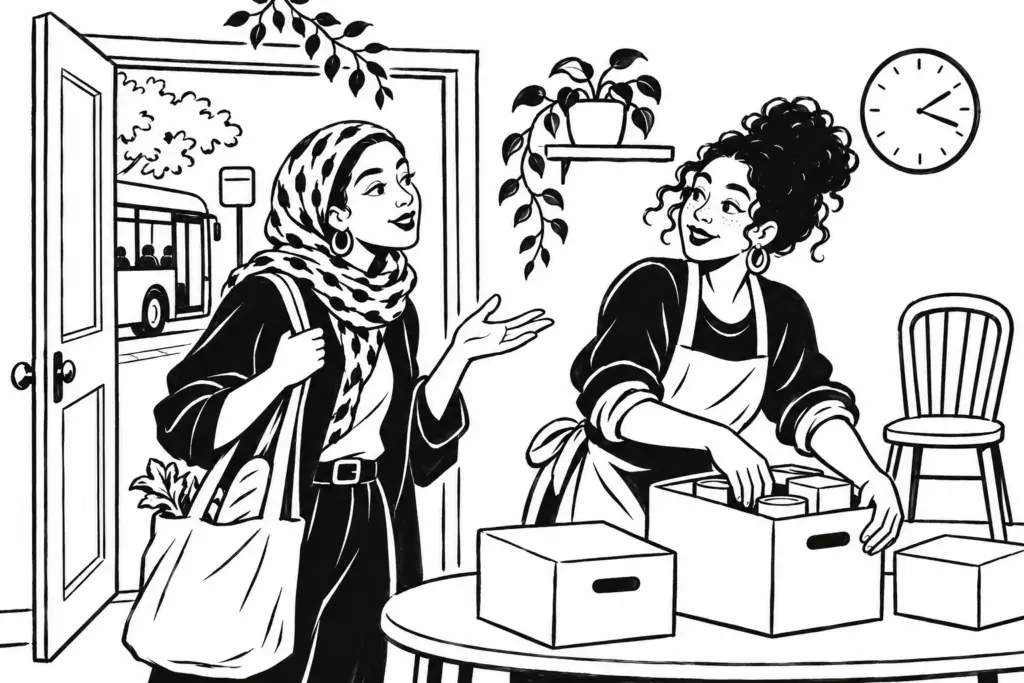
A distribution hall has reopened from nine until eleven. The bus described in the recovery report arrives at half past eleven. The building is usable; the journey is not. Someone will have to absorb that half-hour gap, and the answer will tell us something the reopening photograph cannot.
This is an invented example, not an account of a relief operation. It makes a question about rebuilding concrete: when a service returns, who must do the additional work that makes it reachable, and who can change the arrangement that creates that work?
Participation can move work without moving power
In her April 2024 essay on post-disaster rebuilding, Kaushambi Bagchi challenges relief approaches that involve women by assigning them responsibility for others while leaving unequal decision-making structures in place. Her argument also asks readers to move beyond a binary account of gender and to examine whose knowledge and priorities shape recovery.
Those are arguments about the organisation of relief, not evidence that every instance of volunteering is exploitative. A person may actively want to contribute. The harder question is whether their contribution is treated as a choice, a resource that needs support, or an unlimited capacity on which everyone else’s plan depends.
Return to the fictional hall. If residents are invited to distribute supplies, their involvement might make the service more responsive. But if they must also collect items for everyone who misses the opening hours, participation has acquired a second job. Calling the arrangement community-led would not tell us who chose that job or who can refuse it.
Follow the gap through three possible responses
Imagine three responses to the timetable mismatch. They are alternatives for analysis, not recommendations for an actual emergency.
Keep the timetable and ask neighbours to help. The hall’s staff can finish at eleven, but someone else must organise collection and later delivery. That may work for particular residents. It also requires time, coordination and agreement from the people doing it. A report that counts only the hall’s staffing hours makes this additional labour disappear.
Keep the hall open later. The bus connection may become usable, but a change to opening hours has consequences for the people staffing the service. Their other responsibilities and the resources for the extra period matter. Moving the burden from residents to workers without examining it would only relocate the problem.
Change the transport or distribution arrangement. This may address the mismatch more directly, but the person controlling the hall may not control the bus. A workable response could require another organisation, a different budget or a different distribution point. The issue is then partly about authority: who can bring the relevant decision-makers together?
None of these options can be selected from the timetable alone. What the comparison does establish is that the phrase “access has been restored” needs more explanation. Access depends on the relationship between services and on the work required to connect them.
Ask what the headline leaves outside the count
A recovery report might count a repaired hall, opening hours and supplies distributed. Those measures can describe real achievements. They still leave questions about the people who could not attend, the trips made on their behalf and the time those trips consumed.
Suppose one volunteer collects for three households. The distribution total may look the same as if three people collected for themselves. The work is organised differently, however. If that volunteer stops, a dependence that was invisible in the headline becomes visible in the service.
A fuller account would therefore connect the output to its conditions: who performed the additional tasks, whether they agreed to them, what support was available and what would happen if the arrangement stopped working. These are questions our example raises. They are not observations from a disaster dataset.
A community meeting does not produce one community preference
Bagchi’s attention to inclusion is useful here because a broad label can hide important differences. In the fictional neighbourhood, an early visitor, a bus-dependent visitor and a person staffing the hall may want different opening hours. Describing one participant as the community’s voice does not make those differences disappear.
Consider what would count as influence. A resident could attend a meeting, explain the missed connection and still have no route to change the timetable. Another could be absent but have their proposed alternative considered through an accessible process. Counting seats at the meeting would not capture that distinction.
The relevant question is what happened to the proposal: who considered it, which constraint mattered and why one response was chosen. An account of disagreement can be more informative than a reassuring statement that consultation took place. It shows whether participation affected a decision or merely accompanied it.
Urgency can justify a temporary arrangement without making it permanent
Bagchi also examines how immediate demands can displace questions about longer-term inequalities. There is a real tension to preserve: a service may need to begin before every connection is settled. Waiting for a perfect design can impose costs of its own.
In our example, temporary opening hours might be a reasonable starting point while transport information is incomplete. Once the missed connection is known, the question changes. Can someone revise the arrangement, and what evidence would prompt that review? A temporary decision with a visible review point differs from one that becomes permanent because nobody owns the unresolved problem.
This does not require pretending every constraint is easy to remove. If no feasible change has been identified, say what the constraint is and who is affected. That is more honest than describing the extra labour as a natural willingness to help, or presenting a service as equally usable by everyone.
The repaired hall remains an achievement. Following it into everyday use makes that achievement more intelligible: a building, a timetable, a journey and someone else’s hours are all part of the result. A feminist reading of recovery asks us to keep those hours and the power to rearrange them in view.
Independent interpretation prompted by Bagchi’s essay. The hall, timetable, residents and possible responses are fictional. They illustrate questions about work, authority and participation; they do not establish outcomes for a real recovery programme.