
Can a purchase carry a feminist promise?
Reading the distance between a message of empowerment and the work of producing, selling and using a product.
In this essay
An illustration for this essay.
Start with what is being sold
A slogan on a shirt can express solidarity, market a brand, raise money, or combine those functions. The visible message does not tell us which function dominates. Identify the product, the audience and the action the campaign asks of its audience before evaluating its politics.
Sarah Banet-Weiser’s Empowered studies popular feminism in relation to popular misogyny across media and commercial culture. Its publisher describes an inquiry into how these formations become intertwined. That is a useful starting point for reading circulation and visibility; it is not a product certification.
Follow the promise beyond the image
Compare a campaign’s public words with the commitments it makes possible to check. If it promises a donation, look for the recipient, amount, period and conditions. If it celebrates women’s work, ask what information is available about the people doing that work. A missing disclosure is a limit on what can be concluded.
Keep the different questions separate. A worker’s conditions cannot be inferred from the appearance of a model, and a charitable contribution does not answer every question about a supply chain. Equally, an image alone cannot establish exploitation. Investigation needs records that match the claim.
A slogan and a commitment are different things
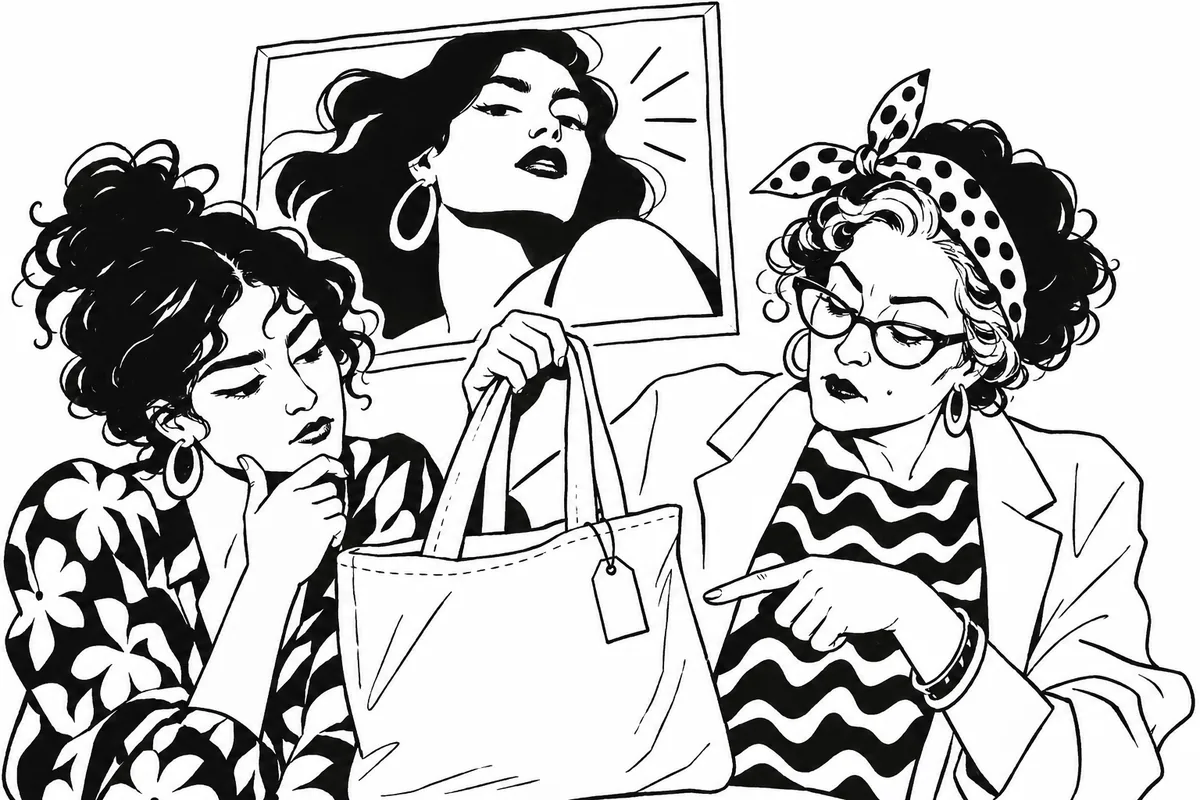
Imagine a tote bag sold with a message about equality. The message tells us what the campaign says. A claim that some proceeds support a programme introduces a separate, checkable commitment. Before drawing a conclusion, identify what “some” means, who receives it and what period the commitment covers. This imagined example is a method for reading a promise, not an accusation against a brand.
A buyer may use that bag to express an affiliation that matters to her. The social meaning of that expression and the seller’s obligations can both be discussed. One need not collapse into the other: a person’s intention is not a supply-chain audit, and a marketing claim is not a complete account of the person who responds to it.
Leave room for people and institutions
People make purchases under constraints of income, time, availability and taste. Turning each purchase into a total judgement of its buyer can reproduce the very individualisation being criticised. Ask instead which responsibilities reasonably belong to sellers, regulators, employers and collective organisations.
A useful reading note therefore has two columns: the change a consumer is invited to perform, and the change an institution would need to make. Where the columns overlap, explain the connection. Where they do not, resist treating participation in a campaign as equivalent to redistribution or accountability.
Sources and further reading
- Sarah Banet-Weiser, Empowered (2018)Duke University Press edition of Popular Feminism and Popular Misogyny.