
Reading postfeminism as a pattern in media
Why confidence, choice and self-monitoring need to be read together rather than as isolated words.
In this essay
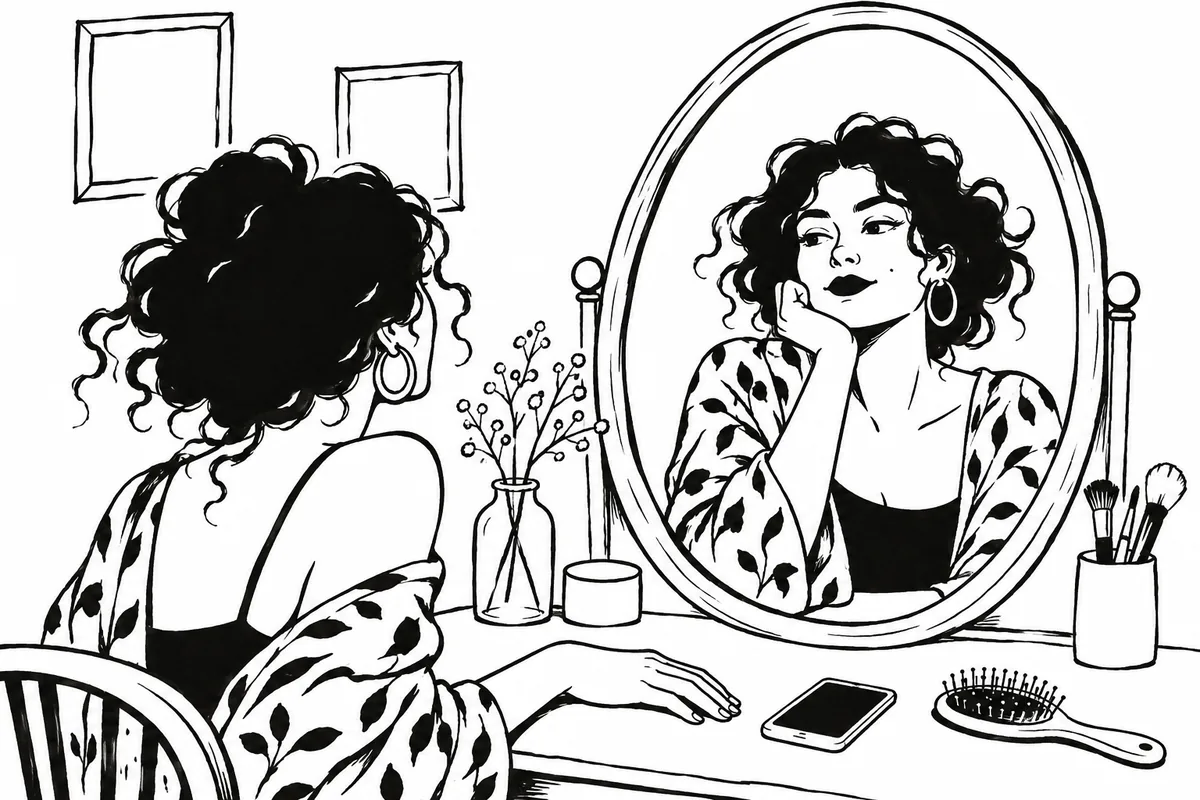
An illustration for this essay.
A sensibility, not a calendar date
In her 2007 article, Rosalind Gill approaches postfeminism as an interlocking media sensibility. Her account connects bodily femininity, self-monitoring, choice, empowerment and makeover narratives. This is more specific than declaring that feminism ended at a particular moment.
The value of that approach lies in relationships between ideas. The word “choice” by itself cannot classify a text. Ask how it is joined to responsibility, appearance, consumption or discipline, and what the combination invites a person to do.
Make a close-reading record
Choose one advertisement, scene or advice column. Describe its format and audience, then identify a claim you can point to directly. Keep description separate from inference: an image may show a person measuring something, while the claim that measurement is presented as freedom requires an account of the surrounding words and framing.
Compare a second example before treating a pattern as general. Similar vocabulary can serve different arguments. A campaign can acknowledge inequality while proposing a personal solution; another can connect personal autonomy to a collective demand. Record the difference rather than making both fit the same category.
When freedom arrives with instructions
A makeover story may celebrate the freedom to choose while providing a narrow script for the right choice. Read the celebration beside the instructions: what should change about a body, an attitude or a routine, and what rewards are promised for that change?
There is no automatic answer. An account of styling or bodily autonomy need not have the same meaning in every setting. Pay attention to what the particular example allows its subject to refuse. Is an alternative represented as a legitimate choice, a failure of effort or something the story cannot imagine? That detail often supports a more careful reading than a broad claim about an entire audience.
Ask what the story leaves out
Who appears to have time, money and freedom to remake a life? Whose labour makes that freedom possible? These questions extend the reading; they do not establish the answers. Look for supporting material before making claims about an audience’s experience or a producer’s intention.
Finally place the material in its own moment. Gill’s article analyses examples from contemporary Anglo-American media of its period. A new platform or format calls for a new reading. A concept can travel, but an old example cannot supply evidence for every later claim.
Sources and further reading
- Rosalind Gill, Postfeminist media culture (2007)Journal record and abstract. DOI: 10.1177/1367549407075898.